A directed graph is like an undirected graph except that edges have direction. Each edge goes from a source node to a target node.
Examples
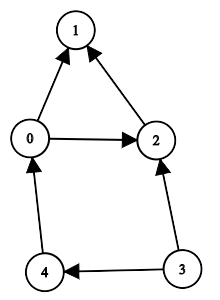
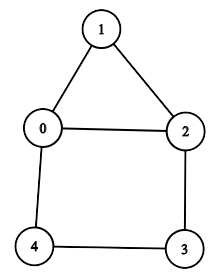
Here, node 0 is adjacent to node 1, but node 1 is not adjacent to node 0, for example. Here is what the graph above would look like if it were undirected:
In directed graphs, the edge direction matters. For example, the following two graphs are different:
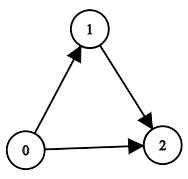
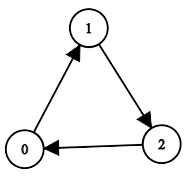
With undirected graphs, the adjacency matrix is symmetric about the main diagonal, but in a directed graph, it is not always the case. In particular, a 1 in row i and column j indicates that there is an edge from i to j.
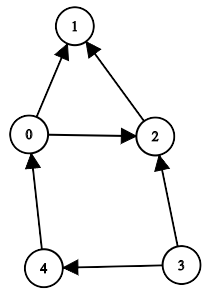
The following graph would have the following adjacency matrix:
{
  {0, 1, 1, 0, 0},
  {0, 0, 0, 0, 0},
  {0, 1, 0, 0, 0},
  {0, 0, 1, 0, 1},
  {1, 0, 0, 0, 0}
}
We can see that node 1 has no edges coming out of it. That is reflected by its row being all zeros. A node with no edges going into it would have a column of all zeros.
Instructions
Your task is to, given the adjacency matrix of a directed graph and two nodes, determine whether or not the first node is adjacent to the second node.
Notes
- Graphs may have between 0 and 25000 nodes.
- Time limit: 100 milliseconds.